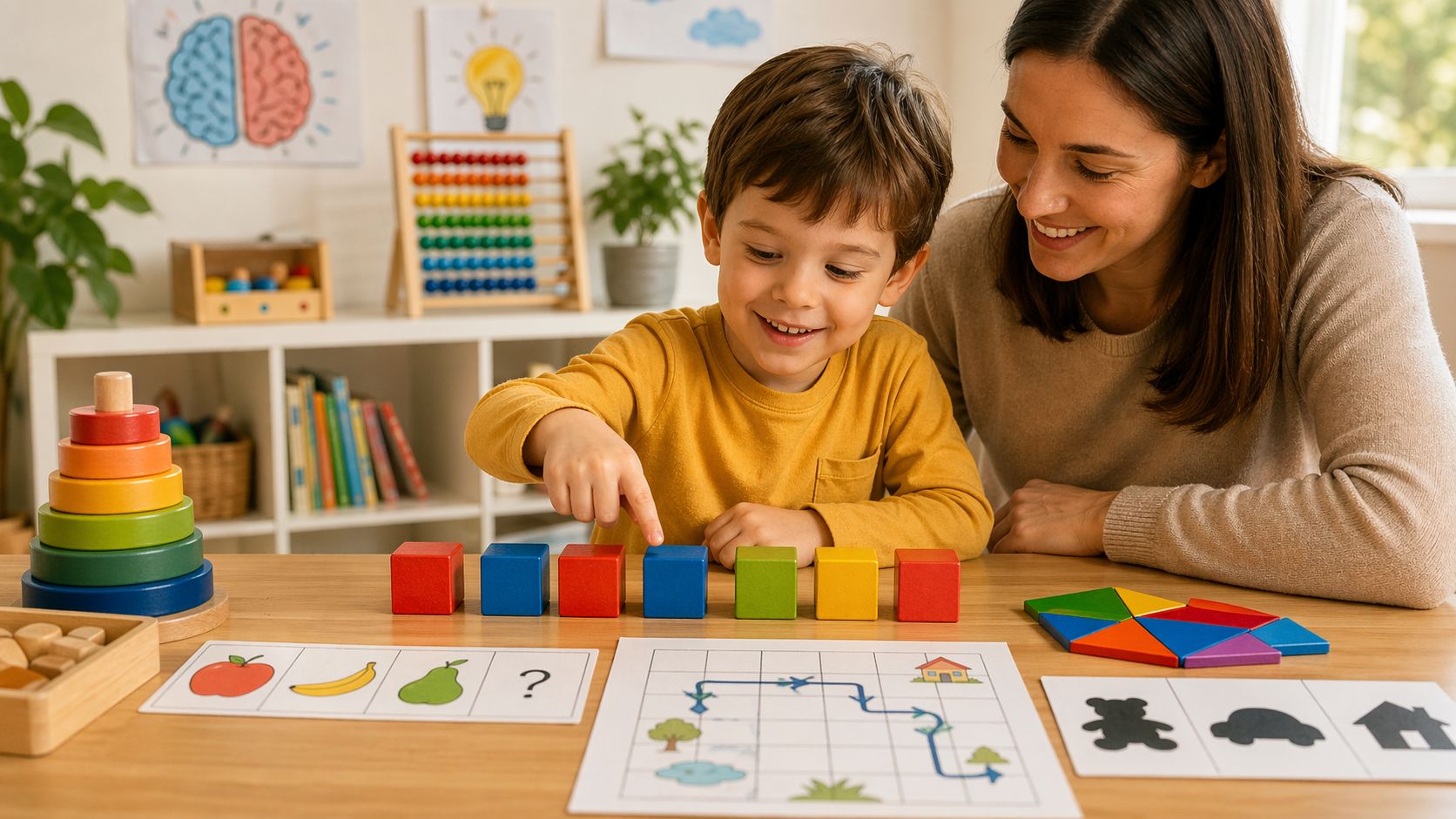
Kids love to play – but did you know that playtime can also support their brain development? Left-hemisphere exercises are simply specially chosen activities that stimulate the left hemisphere of the brain. The left hemisphere is responsible for speech and comprehension, logical thinking, analyzing, calculating, writing, and recognizing objects by touch. These exercises also teach rule acquisition, applying rules, and spotting relationships between elements.
Today, children grow up surrounded by screens, tablets, and toys that intensively stimulate the right hemisphere of the brain. The result? Right-hemisphere dominance and deficits in left-hemisphere functioning. And that can mean difficulties with speaking, reading, writing, counting, and focusing. Left-hemisphere exercises help balance development and prepare your child for school.
Main Types of Left-Hemisphere Exercises
Exercises fall into several categories – each develops different skills, so it’s worth mixing them up.
Sequences
A sequence is an organized chain of elements arranged according to a specific rule. These chains accompany us every day – even when brushing teeth or taking a bath. Working on sequences with children is important because it directly affects brain development, specifically the left hemisphere responsible for speaking, comprehension, and thinking. The pattern of speech can be translated into the pattern of tongue movements during pronunciation of a specific sound – which is why sequences matter so much.
We distinguish between:
- visual sequences – based on pictures, shapes, colors,
- auditory sequences – based on sounds and rhythms,
- movement sequences – based on sequences of body movements.
With visual sequences, always start arranging from left to right. This prepares your child’s eyes and hand for reading and writing in the future.
Series
Series involve arranging elements in the correct order – from smallest to largest, or from lightest to darkest. This is an exercise in logical thinking that develops the ability to compare and classify. Matryoshka dolls, blocks of different sizes, or fruits work great for this.
Coding
Coding is a great game for kids with an element of mystery. The child receives coordinates or specific movements to perform and discovers the path to a hidden treasure. You can literally code anything – objects, colors, animals. It really develops analytical thinking.
Left-Hemisphere Puzzles
Puzzles involve reproducing a given picture made up of different elements. The child learns to arrange things “the same way,” to copy the pattern. You don’t need special aids to practice – you can make them yourself at home.
Relationships
Relationships are exercises in logical thinking and observation. They involve spotting differences between pictures – in color, size, or details. Finding the shadow of an object or character works well here.
Left-Hemisphere Exercises for Children Ages 3–6
Below you’ll find examples of exercises tailored to different age groups. Remember – exercises should match your child’s abilities and bring them joy.
For a 3-Year-Old
At this age, the child is only learning to focus attention, so exercises should be simple and short.
- Imitating a two-element sequence – place two blocks of different colors in front of your child (e.g., red, blue) and ask them to add the next one the same. Start with two elements.
- Arranging Matryoshka dolls – sort the dolls from largest to smallest. A great exercise for series.
- Simple coding – show your child three objects and code their position with simple movements (e.g., two steps left, one step right).
- Sorting objects – ask your child to sort blocks by color or shape.
For a 4-Year-Old
A four-year-old can already focus attention longer and likes to imitate.
- Continuing a sequence – arrange a pattern: red block, blue block, red block and ask your child what comes next.
- Left-hemisphere puzzles – prepare squares of colored paper and show your child a pattern to copy. Start with 2–3 elements.
- Series with fruits – arrange fruits of different sizes from smallest to largest.
- Auditory sequences – name three animals in a row and ask your child to arrange figurines in that order.
- Rhythms – tap a rhythm on the table (e.g., bim bam bom) and ask your child to repeat it.
For a 5-Year-Old
A five-year-old is ready for more challenging tasks and independent work.
- Completing a sequence – arrange a pattern of five elements and leave a gap in the middle, ask your child to fill it in.
- Sudoku for kids – find simple sudoku versions adapted to your child’s age online.
- Coding with a map – draw a simple map with a hidden treasure and give your child the coordinates of steps.
- Puzzles and riddles – introduce simple word riddles and tongue twisters.
- Arranging picture stories – arrange several pictures in logical order together.
For a 6-Year-Old
A six-year-old is preparing for school, so exercises can be more advanced.
- Creating your own sequences – ask your child to arrange their own pattern from available elements.
- Complex puzzles – copy a pattern of six to eight elements, gradually increasing difficulty.
- Visual analysis and synthesis – practice assembling a picture from parts, noticing details and differences.
- Word games – introduce rebuses, simple palindromes, and more complex riddles.
- Puzzles – assembling puzzles develops logical thinking, visual-motor coordination, and spatial thinking.
- Board games – chess, checkers, or simple strategy games teach planning and analysis.
Benefits of Regular Left-Hemisphere Exercises
Systematic practice brings many benefits:
- Better concentration – the child learns to focus on a single task for longer,
- Speech and comprehension development – exercises support proper articulation and understanding instructions,
- Memory support – sequential exercises strengthen working memory,
- Preparation for learning to read and write – the linearity of exercises prepares the hand and eye,
- Logical thinking development – the child learns to spot rules and relationships between elements,
- Improved visual-motor coordination – precise exercises develop fine motor skills.
Left-hemisphere exercises also work well for children with developmental challenges – ADHD, sensory integration disorders, or speech development delays. Before implementing exercises on a larger scale, it’s worth consulting a speech therapist or therapist.
Practical Tips for Parents
Here are a few tips to help you introduce left-hemisphere exercises into play with your child:
- Start with simple exercises – the child must experience success to stay motivated for further work,
- Practice regularly, but briefly – 10–15 minutes a day is enough, preferably in play form,
- Use variety – vary the exercises so the child doesn’t get bored,
- Praise progress – appreciate the child’s effort, not just the end result,
- Don’t compare to others – every child develops at their own pace,
- Use objects from your surroundings – you don’t need expensive aids, blocks, crayons, beans, or pictures cut from colored paper work great,
- Work from left to right – always arrange elements in this direction, preparing your child for reading and writing.
Summary
Left-hemisphere exercises are a good workout for a developing mind and great fun at the same time. You can organize them at home without spending a fortune on specialized aids. Thanks to their variety, they can be adapted for every child, regardless of age. Regular practice of sequences, series, coding, puzzles, and relationships supports concentration, memory, logical thinking, and prepares your child for learning to read, write, and count.
And most importantly – play along with your child. When play is enjoyable, learning comes naturally.