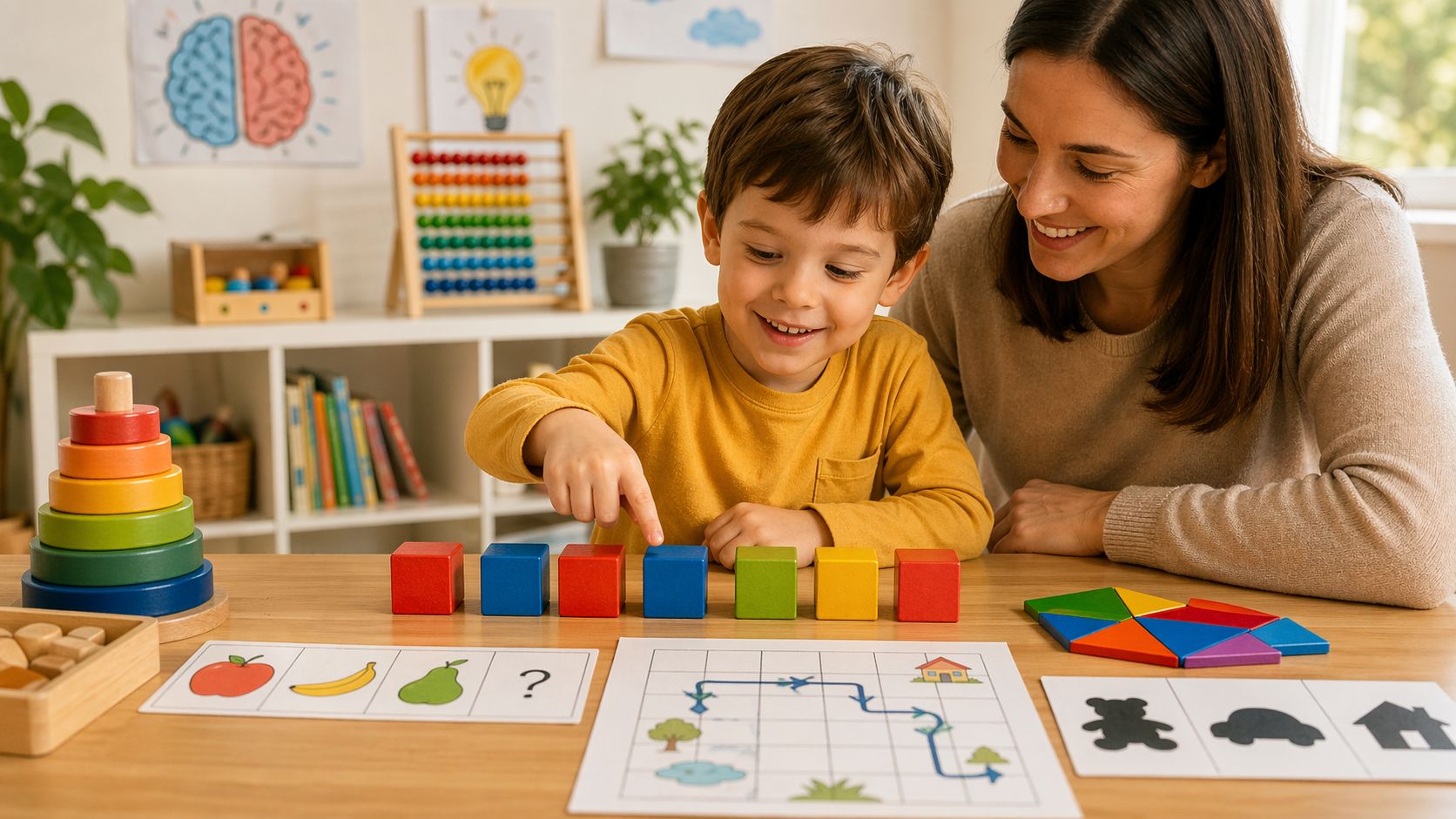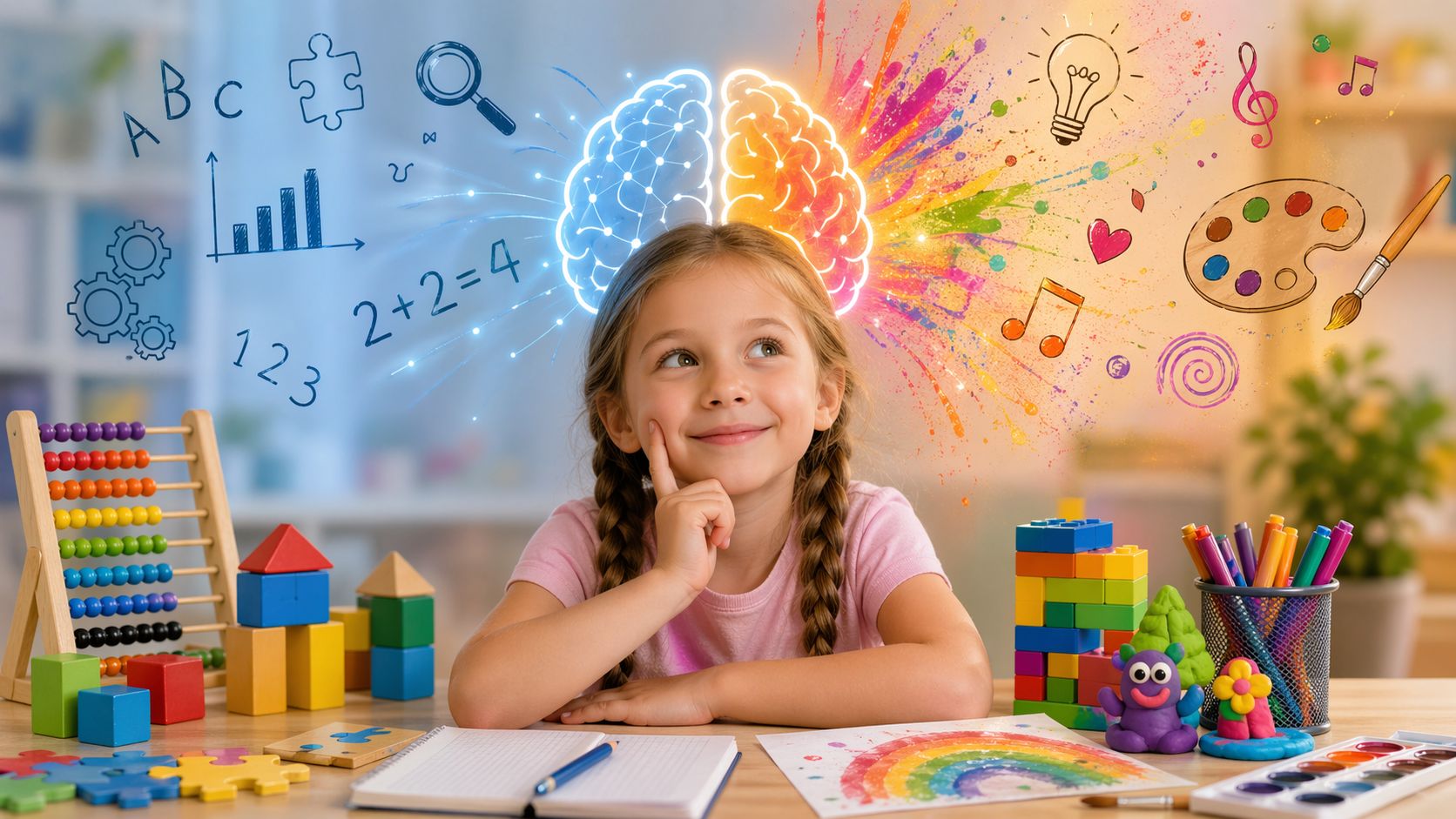
The brain consists of two parts — the left and right hemispheres. Each has its own job. The left hemisphere handles logical thinking, language, analysis, and precision. You could call it the internal “accountant” — it likes order and sequences. The right hemisphere is the “artist” — it handles creativity, imagination, emotions, and pattern recognition. It sees the whole picture, not the details.
The two hemispheres are connected by the corpus callosum — a kind of neural bridge. The better these two parts communicate with each other, the faster you think, the easier you learn, and the better you solve problems. In children, this cooperation affects concentration, reading, writing, and even how they cope with stress.
That’s why it’s worth supporting the development of both hemispheres through play and exercises. Below you’ll find 25 simple exercises you can do with your child at home — no special equipment or lots of time needed.
Cross-Movement Exercises
Cross movements stimulate neural connections between both sides of the brain. They engage opposite limbs, which makes both hemispheres work together.
- Cross walking — The child lifts the right knee and touches it with the left hand, then switches sides. You can also walk in place, alternately lifting knees and touching them with the opposite hand.
- Alternating swinging — The child stands freely and alternately swings the right hand with the left leg, then the left hand with the right leg. Slowly at first, then a bit faster.
- Touching opposite limbs — The child sits or stands and touches the left foot with the right hand, then the right foot with the left. You can vary this by touching knees or elbows.
- Cross crawling — The child crawls, simultaneously pushing out the right arm and left leg, then the left arm and right leg. Works great for younger children.
- “Give yourself a compliment” exercise — The child stands, touches the left ear with the right hand and says “I am smart,” then touches the right ear with the left hand with a different compliment. Simple, but engages both hemispheres.
Fine Motor and Manipulative Exercises
Tasks requiring precise hand work engage both hemispheres at once. The left hemisphere plans movement, the right handles spatial imagination.
- Drawing with both hands — The child draws with both hands simultaneously. Start with simple lines and circles, then move to more complex patterns. They can also draw two different shapes at the same time.
- Writing with both hands — The child writes or traces letters with both hands. At first, have them write the same symbols with both hands, then different ones.
- Puzzle assembling — Puzzles develop spatial and logical abilities. Gradually increase the number of pieces, matching the child’s age.
- Modeling with clay or playdough — Shaping forms engages the small muscles of the hands and imagination. Make animals, characters from favorite cartoons — whatever the child comes up with.
- Origami folding — Paper folding requires precision and spatial imagination. Start with simple shapes like a boat or airplane.
- Building with blocks — Constructing towers, bridges, other structures develops spatial thinking. Lego, wooden blocks, magnetic blocks — whatever you have on hand.
Musical and Rhythmic Exercises
Music naturally stimulates both hemispheres — the left processes rhythm and notes, the right responds to melody and emotions.
- Playing instruments — The child can play simple instruments: drums, maracas, bells. Important to use both hands and engage the whole body.
- Singing and movement — Sing songs and dance — classical, jazz, rock, whatever suits you. Add movements that engage both sides of the body.
- Clapping to rhythm — Clap your hands, beat on your thighs, stomp. Change rhythms, speed up and slow down.
- Lazy eights — The child draws an infinity symbol in the air or on paper with one hand, then the other, finally both at once. Great for concentration.
- Dance with alternating movements — Invent simple dance moves where the right hand does something different than the left, and the legs move too.
Mental Games and Activities
Thinking, problem-solving, and creativity are best developed through play.
- Word games — rebuses and riddles — Solve rebuses, riddles, sayings with hidden meanings. The child must combine logical thinking with creativity here.
- Stroop effect — naming colors — Prepare words denoting colors (e.g., “red,” “green,” “blue”) written in a different font color. The child’s task is to name the font color, not the word. It’s difficult but very effective.
- Crosswords and sudoku for kids — Simple puzzles develop logical thinking. Start with easy versions.
- Symmetry game — The child creates symmetrical patterns from blocks, colored rubber bands, paints, or leaves. They can also draw the second half of a picture as a mirror image.
- Board games and card games — Games requiring strategic thinking and planning develop hemisphere cooperation. Choose games appropriate for the child’s age.
Breathing and Relaxation Exercises
Conscious breathing helps the brain calm down and focus better. This is an important part of working with hemispheres.
- Deep “belly” breathing — The child places a hand on their belly and breathes so the hand rises and falls. Inhale through the nose, exhale through the mouth. A few repetitions.
- “Balloon” exercise — The child imagines their belly is a balloon. Inhale — the balloon grows, exhale — it shrinks. A minute or two of this exercise.
How to Introduce These Exercises?
Have fun, don’t force. Exercises should be enjoyable play, not a chore. A few tips:
- Start with a few minutes a day, gradually extend the time.
- Match exercises to the child’s age and abilities.
- Some children like repeating their favorite games — there’s nothing wrong with that.
- Movement exercises work best before studying.
- Consistency matters more than intensity — better 10 minutes a day than an hour once a week.
Summary
Stimulating brain hemispheres is primarily about movement, play, and interesting challenges. Through these exercises, you support the development of concentration, memory, creativity, and learning ability. Remember, every child develops at their own pace.
Your role as a parent is not just supervision — it’s primarily about playing together and building bonds. Exercises integrating brain hemispheres are a good opportunity to spend time with your child while supporting their development.